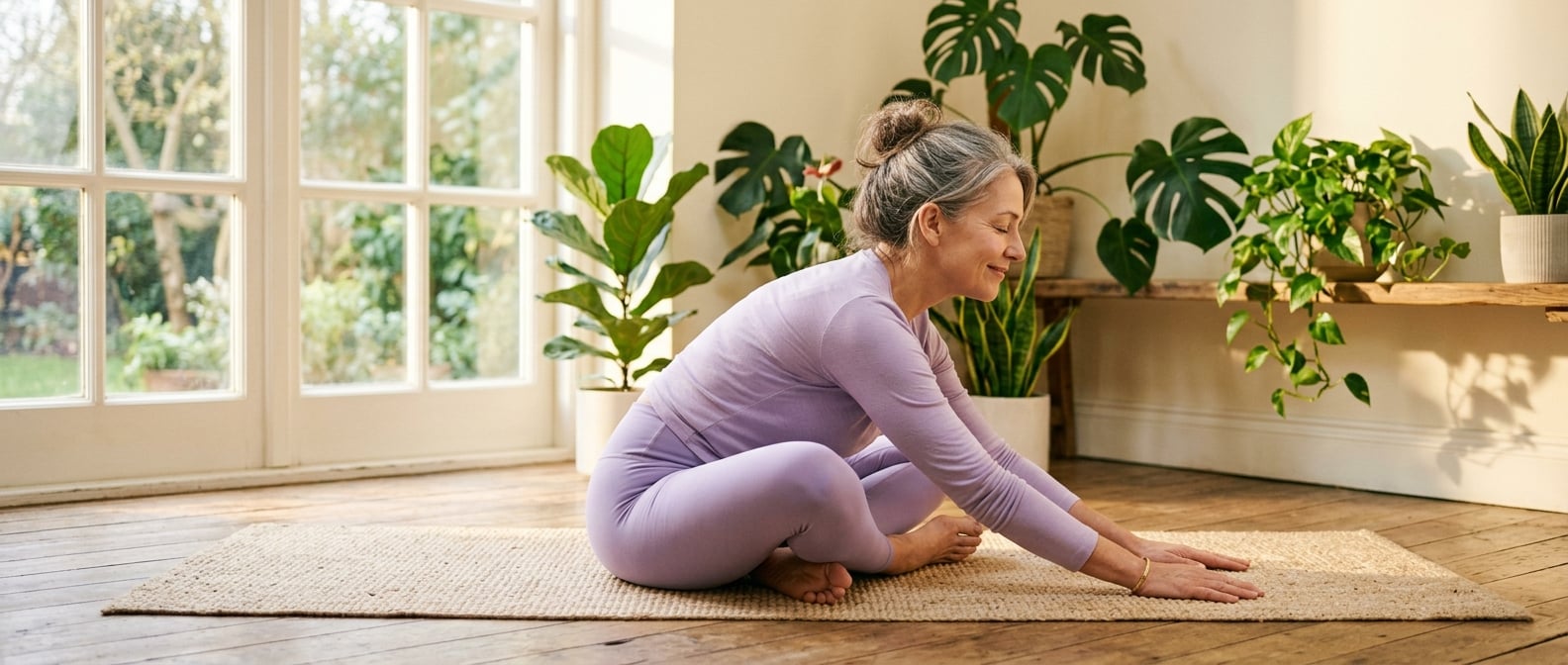
Why Your Joints Feel Different Now
If you have noticed more stiffness in the morning, achy knees or hips, or shoulders that just do not move the way they used to, you are not imagining it — and it is not simply "old age." Estrogen is quietly involved in keeping your joints healthy, and as it declines during perimenopause and menopause, joints often feel the change.
Estrogen has anti-inflammatory properties, helps your body make collagen (a building block of cartilage and connective tissue), and supports the lubricating fluid inside your joints. As levels fall, many women experience more inflammation, less cushioning, and stiffer, achier joints — often in the hands, knees, hips, and shoulders.
The good news: movement is one of the most effective remedies. Gentle daily stretching improves range of motion, eases morning stiffness, and keeps the joints lubricated. You do not need a gym — just a few minutes a day.
Before You Start
- Warm up first. Stretching is most effective and safest when your body is warm — after a short walk, or even after a warm shower.
- Move slowly and breathe. Never bounce or force a stretch. Ease into it and hold gently.
- Aim for mild tension, not pain. You should feel a comfortable stretch, never a sharp pain.
- Consistency beats intensity. Five to ten minutes every day does far more than one long session a week.
A Simple Daily Stretch Routine
These gentle moves target the areas most affected by menopause. Hold each for 20–30 seconds (or as noted) and repeat 1–2 times.
1. Cat-Cow (spine and back)
On your hands and knees, slowly arch your back up toward the ceiling (cat), then let it gently dip as you lift your head and tailbone (cow). Flow slowly between the two for 30–60 seconds. This wakes up a stiff spine beautifully in the morning.
2. Seated Neck & Shoulder Release
Sitting tall, gently drop one ear toward your shoulder until you feel a stretch along the side of your neck. Hold, then switch sides. Follow with slow shoulder rolls backward. Great for tension that builds from poor sleep.
3. Scapular Squeeze (upper back and posture)
Sitting or standing, draw your shoulder blades gently back and down, as if trying to hold a pencil between them. Hold 5 seconds, release, repeat 10 times. This counters the rounded-forward posture that stiff shoulders create.
4. Standing Child's Pose (shoulders and back)
Place your hands on a counter or table, step back, and hinge at the hips until your arms and back lengthen. Let your chest sink gently toward the floor. Wonderful for tight shoulders and an achy lower back.
5. Seated Hip Flexor & Figure-Four (hips)
Sitting on a chair, cross one ankle over the opposite knee and gently lean forward with a flat back until you feel a stretch in the hip and glute. Hold, then switch sides. Hips are one of the most common menopause stiffness spots.
6. Gentle Hamstring Stretch (legs and lower back)
Sitting on the edge of a chair, extend one leg with the heel on the floor and toes up. Sit tall and hinge forward slightly from the hips until you feel the back of the thigh lengthen. Switch sides. Tight hamstrings pull on the lower back and worsen stiffness.
7. Wrist & Finger Stretches (hands)
Many women are surprised by achy, stiff hands in menopause. Gently extend one arm, palm up, and use the other hand to draw the fingers back. Then make slow fists and spread the fingers wide, 10 times. Simple but very relieving.
8. Standing Calf & Ankle Circles (lower legs)
Step one foot back, keep the heel down, and lean into a wall to stretch the calf. Finish with slow ankle circles in both directions. Keeps you steady and mobile on your feet.
Make It Stick
- Anchor it to a habit — stretch right after brushing your teeth, or while your morning coffee brews.
- Morning eases stiffness; evening aids sleep. A few gentle stretches before bed can also help you relax.
- Pair with the basics. Low-impact movement (walking, swimming, cycling), light strength training to support the joints, staying hydrated, and an anti-inflammatory diet rich in omega-3s all amplify the benefits.
- Heat helps. A warm shower or heating pad before stretching relaxes stiff muscles; cold packs can calm an inflamed joint afterward.
Listen to Your Body
Some stiffness that eases with movement is normal in menopause. But if you have joint pain that is severe, swollen, red, or does not improve, check in with your doctor — it is always worth ruling out other causes, and treatments like physical therapy or hormone therapy may help.
Tracking your joint pain daily helps you see whether your new stretch routine is actually working. Over a few weeks, you may notice your stiffness scores trending down — proof that those few minutes a day are paying off.
GoBloomWell lets you track joint pain and stiffness alongside your other symptoms, so you can see whether daily stretching is easing your aches over time. Start tracking for free today.